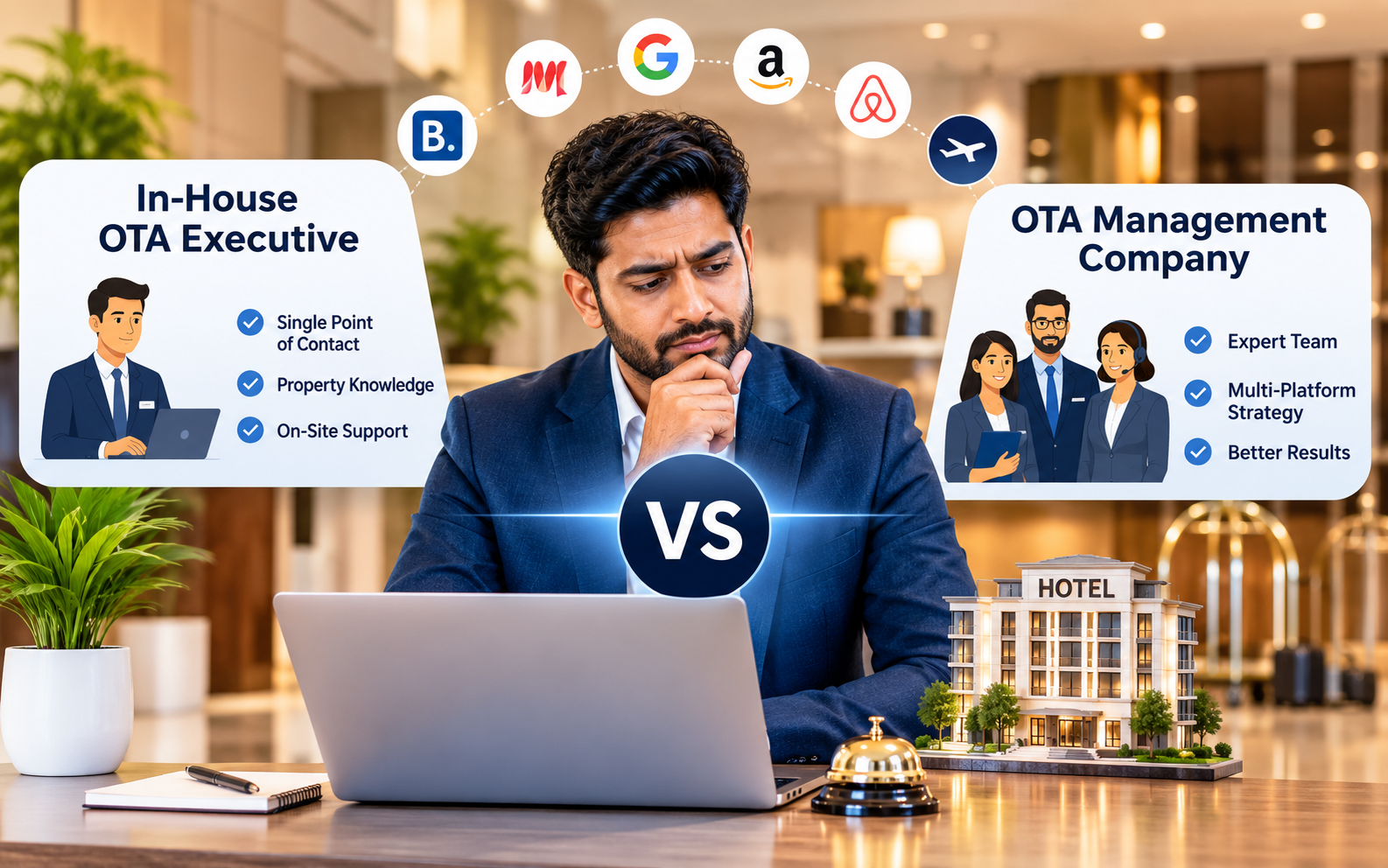
For most independent hotels with fewer than 60 rooms, an OTA management company delivers more bookings for less total cost than an in-house OTA executive, because you get a full team, wider market data and cover on every day of the year usually for less than the true cost of one hire. Larger properties and groups often do best with both. An OTA management company is an outside team that runs your listings on platforms such as MakeMyTrip, Booking.com and Agoda: rates, inventory, content, promotions, reviews and reporting.
The trouble is that most owners compare only a salary with a monthly fee, and that is the wrong comparison. In this guide you will see what each option really does, what each one truly costs, where each wins on results, how to protect your accounts, and a 10 question scorecard that tells you which model fits your hotel.
What Does an OTA Management Company Do?
An online travel agency (OTA) is any platform that sells your rooms to travellers for a commission: MakeMyTrip and Goibibo, Booking.com, Agoda, Expedia, Cleartrip, EaseMyTrip and Airbnb are the ones most Indian hotels use. OTA management is the daily work of making those listings rank, convert and pay out correctly. Getting listed is only step one. Our OTA listing service covers that setup. Management is what happens every day after go-live.
The daily work
A good outside team handles six areas:
-
Rates and inventory. Updating prices and room availability on every OTA platform, closing out sold dates and opening rooms when cancellations come in.
-
Content. Photos, room descriptions, amenities and policies kept complete, because OTAs score listing quality and rank complete listings higher.
-
Visibility. Choosing which promotions, deals and paid placements to join, and when to step out of them.
-
Reviews. Replying to guest reviews and working with your front office to collect more of them.
-
Platform relationships. Speaking regularly with each OTA's market manager to get your hotel into campaigns and to fix problems quickly.
-
Reporting and reconciliation. Tracking revenue, room nights and average room rate (ARR) by channel, and checking that commissions and payouts match bookings.
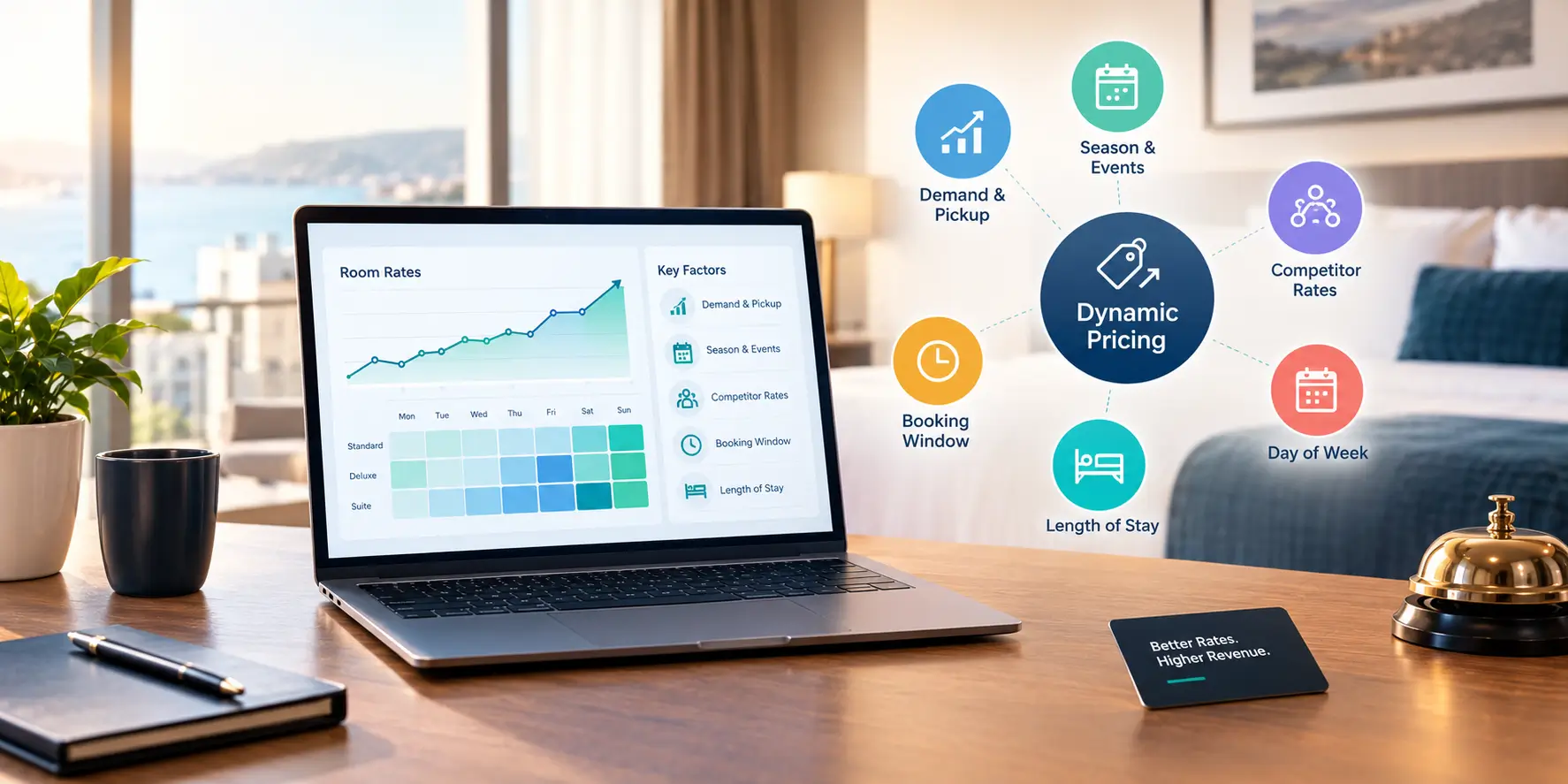
The best providers also connect OTA work to pricing. A listing that ranks well but sells every room too cheaply is not a success. That is why OTA work sits inside revenue management at RevAlpha, alongside dynamic pricing for hotels and demand forecasting.
What it should not do
An outside team should not take ownership of your accounts, hide what it changes or lock you into long contracts with no exit. It also does not replace your front office. Check-ins, guest calls and on-property service stay with your team. We cover the safeguards in the section on control and risk below.
What Does an In-House OTA Executive Do?
An in-house OTA executive is a staff member, often from front office or reservations, who manages your extranets as part or all of their job. In smaller hotels this is frequently the front office manager or the owner's trusted reservations person, who "also handles the OTAs".
A typical week
-
Logging in to five to eight extranets each morning to check new bookings, cancellations and modifications.
-
Updating rates and inventory, either portal by portal or through a channel manager for hotels.
-
Answering guest messages on each platform.
-
Uploading new photos or fixing a policy when an OTA flags it.
-
Saying yes or no to promotions the OTA market manager suggests on a call.
-
Sending the owner a booking summary, often in a spreadsheet.
Where the role starts to strain
An executive is close to the property. They know the rooms, the guests and the front desk, and they can fix a booking problem in minutes. That is real value.
The strain shows in three places. First, one person is a single point of failure. When they are on leave, ill or resign, nobody updates rates and the listing quietly drops in ranking. Second, they see only one hotel. They do not know which promotions are working for similar properties across the state, or what changed in an OTA's ranking rules last month. Third, the work is mostly reactive. Daily updates crowd out the analysis that actually grows revenue: which channel is under-performing, which dates are selling too cheaply, which competitor just moved their rate.
None of this is the executive's fault. It is a structural limit of asking one person to do the work of a team.
Side-by-Side: The Two Models Compared
Before looking at money, compare what each model actually gives you. The table below covers the points owners ask us about most.
Factor | In-house OTA executive | Outside OTA team |
People working on your listings | One person, often part-time on OTAs | A team: account manager, content, pricing and reporting support |
Cover during leave or resignation | None, unless you train a backup | Built in |
Market view | Your hotel only | Many hotels across many markets |
OTA market manager access | Your hotel's own contact | Ongoing relationships across platforms |
Speed on property issues | Very fast, on site | Fast if the process is set up, but remote |
Pricing expertise | Varies widely | Usually part of the service |
Tools | You buy them | Often included or shared |
Reporting | Depends on the person | Fixed weekly or monthly format |
Hiring and training | Your job, repeated each time someone leaves | The provider's job |
Accountability | Through your HR process | Through the contract and results |
Where the in-house executive wins
An in-house person is unbeatable on property knowledge and speed. If your hotel runs a lot of walk-ins, group bookings or wedding blocks that change daily, someone on site who can update inventory instantly is very valuable. Hotels with 80 or more rooms, or with a busy banquet business, usually need at least one person in this seat.
Where the outside team wins
An outside team wins on breadth and consistency. It brings tested playbooks from many properties, knows which promotions pay back in your market, keeps working when someone is on leave, and reports on revenue rather than on tasks. For independent hotels looking at OTA management for hotels without building a department, that combination is hard to match with one hire. Our earlier comparison of outsourced hotel revenue management vs an in-house revenue manager shows the same pattern for the senior pricing role.
The Real Cost of Each Option
Owners usually compare a monthly OTA executive salary with a monthly agency fee. That leaves out most of the true cost of a hire, and most of the value of a team.
The cost of an in-house executive
The salary is only the start. When you hire, you also pay:
-
Statutory contributions. Where the Employees' Provident Fund applies, employers and employees each contribute 12% of wages, and the employer also pays administration and EDLI charges, according to the Government of India's national portal.
-
Hiring and training. Advertising, interviews and several weeks before a new person is fully productive. Repeat this every time someone leaves.
-
Tools. A channel manager, a rate-shopping tool and sometimes a review tool, if the executive is to work efficiently.
-
Supervision. Your time, or a manager's time, checking their work and setting direction.
-
Gaps. Revenue lost on the days nobody updates rates or answers an OTA query.
How outside teams charge
Most providers in India use one of three models:
-
Fixed monthly fee. Predictable and easy to budget. Check exactly which OTAs and tasks are included.
-
Percentage of OTA or room revenue. The provider earns more when you earn more. Check whether the percentage applies to all revenue or only to growth.
-
A smaller fixed fee plus a performance share. A middle path that keeps both sides focused on results.
OTA commissions are separate from the management fee in every model. You pay those to the OTAs either way.
A simple cost worksheet
Fill in your own numbers. We have not used sample figures, because salaries and fees vary a lot by city, hotel size and scope.
Line | In-house executive (per year) | Outside team (per year) |
Salary or fee | Annual CTC | 12 x monthly fee, or estimated revenue share |
Statutory costs | EPF and other contributions, where they apply | Included in the fee |
Hiring and training | Recruitment cost plus training weeks | Onboarding, usually included |
Tools | Channel manager, rate shopper, review tool | Check what is included |
Leave and turnover | Estimated revenue lost on uncovered days | Covered by the team |
Total cost | Add the lines | Add the lines |
Expected OTA revenue | Your current trend | Your current trend plus a realistic uplift |
Compare revenue minus cost, not cost alone. A cheaper option that grows OTA revenue more slowly is usually the expensive one.
Where Each Model Wins on Results
Cost matters, but the bigger number is revenue. Here is where the two models tend to differ on outcomes.
Ranking and content
OTAs rank listings partly on content quality, review scores, price competitiveness and conversion. An outside team that manages many properties knows what a complete listing looks like on each platform and keeps it that way. An executive juggling front-desk work often lets photos, amenities and policies drift out of date. Our work with Aayush Resort in Karjat started with exactly this: the listings were incomplete, the resort sat outside the top 30 on Karjat searches, and content was the first fix.
Rate parity and channel mix
When the same room shows different prices on different OTAs, or on your own website, guests notice and OTAs can push you down in search. Keeping parity across six or more platforms is simple in theory and hard in a busy week. Watching the full channel mix also matters. A single OTA can drop while total revenue still grows, if someone is actively moving effort to the channels that are working.
Coverage on the days that matter
Demand peaks do not wait for staff rosters. Travel inside India keeps rising: the Ministry of Tourism recorded 2,948.19 million domestic tourist visits in 2024, a 17.51% increase over 2023. And those travellers are online. TRAI reported 1,092.79 million internet subscribers in India as of 31 March 2026. More travellers searching on their phones means more long weekends, festivals and event dates where rates and inventory need attention on the same day. A team covers those days. One person often cannot.
This is where ota revenue management matters more than task lists. The goal is not "listings updated", it is more room nights at a better ARR.
Control and Risk: Who Owns Your OTA Accounts?
This is the question most competitor guides skip, and it is the one that causes the most regret. Whichever model you choose, your hotel must own its accounts.
Access rules to set on day one
-
The OTA accounts stay in your hotel's name, registered with a hotel email address and phone number that you control, not an employee's or an agency's personal details.
-
Give user access, not your master login. Most major OTA extranets let you add separate users with their own logins. Use that, so you can remove access in one step.
-
Keep a written list of every platform, login and user with access, and review it every quarter.
-
Bank details and payout settings stay with the owner or accounts team. Nobody running day-to-day OTA work needs to change where your money goes.
These rules matter just as much for an in-house executive. Hotels lose access to their own listings when an employee leaves with the only password far more often than people admit.
Contract terms to insist on
If you outsource OTA management, get these in writing:
-
A clear scope: which OTAs, which tasks, and what is excluded.
-
A reporting format and frequency, with revenue, room nights and ARR by channel.
-
Response times for urgent issues such as a wrong rate or an overbooking.
-
A notice period you can live with and a handover checklist on exit.
-
Confirmation that all content, photos and data created for your listings belong to your hotel.
-
No guaranteed-revenue promises. Results depend on your property and market, and an honest provider says so.
Compliance work deserves a mention too. Payouts, commissions and taxes need regular reconciliation. Tax settings also change: the PIB factsheet on recent reforms confirms that GST on hotel rooms priced below ₹7,500 per day was cut from 12% to 5%, without input tax credit. A change like that has to be reflected correctly on every extranet, and someone has to own it. Ask whichever option you choose who checks this, and how often.
Which Option Fits Your Hotel? A 10-Question Scorecard
Answer each question with yes or no. Give yourself one point for every "yes".
-
Do you have fewer than 60 rooms?
-
Is the person handling OTAs also doing front office or reservations work?
-
Have you lost your OTA person, or had long gaps in cover, in the last two years?
-
Are you on four or more OTAs?
-
Do you change rates fewer than four times a month?
-
Are any of your listings missing photos, amenities or policies right now?
-
Does one OTA bring in more than half of your OTA revenue?
-
Do you get a monthly report showing revenue, room nights and ARR by channel? (Score one point for "no".)
-
Has your OTA revenue been flat or falling for six months?
-
Is the owner personally approving most OTA promotions?
Reading your score
-
0 to 3: Your in-house setup is probably working. Tighten it with a backup person, a clear weekly report and the access rules above.
-
4 to 6: You are carrying risk. Consider the hybrid model below, or ask for an outside review of the last 90 days.
-
7 to 10: It is time to outsource OTA management. One person, however good, cannot cover this much.
If several of these points sound familiar, our checklist of the 10 signs your hotel needs a revenue management company goes deeper on each one.
How property type changes the answer
-
Budget hotels with 10 to 20 rooms rarely have the budget for a dedicated executive, so an outside team is usually the only way to get daily OTA attention.
-
Villas and homestays depend heavily on Airbnb and Booking.com content and reviews, which an outside team can manage remotely.
-
Resorts need different strategies for weekdays, weekends, long weekends and seasons, which rewards a team that has seen the same pattern in other resort markets.
-
Groups of hotels often keep an in-house person per property and add an outside team for strategy, reporting and consistency across properties.
The Hybrid Model: When Both Work Together
You do not always have to choose. Many hotels keep their reservations or front office person on the extranets for day-to-day operations and bring in an OTA management company for strategy, pricing, content, promotions and reporting. Each side does what it is best at.
The hybrid model works well when your hotel has a lot of on-site activity (groups, events, walk-ins) and you still want the expertise and market view of a specialist team. It also helps when an owner is not ready to let go of an executive who knows the property well. Instead of replacing that person, you give them a team to work with.
The key is a clear split of duties. Without one, both sides assume the other has done the update, and mistakes follow.
A sample split of duties
Task | In-house person | Outside team |
Live inventory changes from walk-ins, groups and events | Owns | Informed daily |
Daily rate strategy and rate changes | Informed | Owns |
Listing content, photos and policies | Supplies photos and updates | Owns optimisation |
Promotions and paid placements | Approves for owner | Recommends and runs |
Guest messages on OTAs | Owns | Supports with templates |
Review replies | Supports | Owns |
Payout and commission checks | Accounts team owns | Flags gaps in reports |
Weekly performance report | Reads and acts on property points | Owns |
Agree the split in writing, review it after the first month, and adjust.
How to make the hybrid model work
Set up one shared channel, such as a WhatsApp group or a shared sheet, where every inventory change from the property is posted the moment it happens. Hold a 15-minute call each week to review the next 30 days: which dates are filling fast, which promotions are running and what the property team knows that the data does not, such as a wedding enquiry or a road closure. Finally, make one person at the hotel the final decision-maker on anything that affects guests on site. Clear ownership is what stops two capable teams from undoing each other's work.
What This Looks Like in Real Hotels
The examples below come from RevAlpha's published case studies. Each one started with a different OTA problem. Results are specific to each property and market, and we do not guarantee outcomes.
-
Weak listings and low ranking. Aayush Resort in Karjat sat outside the top 30 on OTA searches for its location. After rebuilding content, running promotions and splitting weekday and weekend pricing, the resort reached #3 in its location, and OTA revenue grew 128% in August 2026 compared with August 2025.
-
A new hotel with no OTA history. Hotel Ratna Paradise, a 25-room hotel in Thane West, needed its OTA presence built after onboarding in July 2025. With pricing, competitor monitoring and management of the full channel mix, overall OTA revenue grew 52.75% year on year, even though two individual OTAs declined.
-
Deep seasonality. Hotel Prince in Jaisalmer faced very quiet summer and monsoon months. Seasonal pricing and active OTA management lifted room nights from 131 in January to October 2025 to 403 in the same months of 2026, with OTA revenue up 222%.
-
Starting from zero. Hotel Vianta in Jaigaon, a newly built 29-room hotel, had no OTA presence at all. Since February 2026 it has generated ₹16.15 lakh in OTA sales and 577 room nights.
-
Keeping growth going over years. Malad Inn in Mumbai has worked with Hospitality Minds since 2020. OTA sales grew 36.6% and room nights 51.3% in January to October 2026 compared with the same period in 2024.
The common thread is not one trick. It is steady, expert attention to content, pricing, visibility and channel mix, week after week. That is what good OTA management services for hotels look like. You can see all results on our success stories page.
How to Switch Without Losing Bookings: A 30-Day Plan
Whether you are moving from an executive to an outside team, or to a hybrid setup, plan the change so that no dates are left unmanaged.
Days 1 to 7: Audit and access. List every OTA, login and user. Confirm the accounts are in the hotel's name. Pull the last 12 months of OTA revenue, room nights and ARR by channel, so you have a baseline. Create user access for the new team rather than sharing your main password.
Days 8 to 14: Fix the basics. Complete missing content, correct room mapping and policies, and check that rates match across channels. If you do not use a channel manager, decide now whether you need one. Our technology and software page explains the options.
Days 15 to 21: Strategy and handover. Agree the rate strategy for the next 90 days, including weekends, festivals and local events. Agree the split of duties in writing. If an existing executive is staying, they shadow the new process for a week.
Days 22 to 30: Run, report, review. Hold the first weekly report review. Check what changed, what was booked and what is planned. At day 30, compare against your baseline for the same weeks last year, not against last month.
Judge revenue impact fairly over at least one full quarter, and ideally a full season.
Mistakes to avoid during the switch
-
Switching in peak season. Make the change in a quieter month, so any teething problems cost less.
-
Changing everything on day one. Fix content and parity first, then adjust pricing strategy once the baseline is clear.
-
Leaving the old executive out of the loop. Even if they are moving to another role, their knowledge of past problems and guest patterns is worth a proper handover meeting.
-
Skipping the baseline. Without last year's numbers by channel, you cannot tell whether the new setup is working.
Conclusion
Choosing between an OTA management company and an in-house OTA executive is not really a choice between a fee and a salary. It is a choice between one person's time and a team's system. An in-house executive is excellent for speed and property knowledge. An outside team brings breadth, cover on every day of the year, tested playbooks and reporting built around revenue.
For most independent hotels under 60 rooms, outsourcing OTA management delivers more for less. For larger properties and groups, the hybrid model often works best. Whatever you choose, keep the accounts in your hotel's name, give user access rather than master logins, and measure results on revenue, room nights and ARR.
If you scored four or more on the scorecard, it is worth a second opinion. Send us your last 90 days of OTA data and our hotel revenue management company team will show you where bookings and rate are being lost, and which model suits your property. Get a proposal from RevAlpha.
Frequently asked questions
For most independent hotels under 60 rooms, an OTA management company is the better choice, because you get a full team, wider market knowledge and cover on every day of the year, usually for less than the true cost of one hire. Larger hotels and groups often benefit from keeping an in-house person for daily operations and adding an outside team for strategy and reporting.
Providers in India usually charge a fixed monthly fee, a percentage of OTA or room revenue, or a smaller fixed fee plus a performance share. OTA commissions are paid separately to each platform. Compare total cost, including the hidden costs of a hire, against expected revenue, and ask every provider for the full scope and exit terms in writing.
You should not. Your OTA accounts must stay registered in your hotel's name, with your email and phone number. Give the outside team separate user access rather than your main login, keep bank and payout settings with the owner or accounts team, and make sure your contract confirms that all content and data belong to your hotel.